
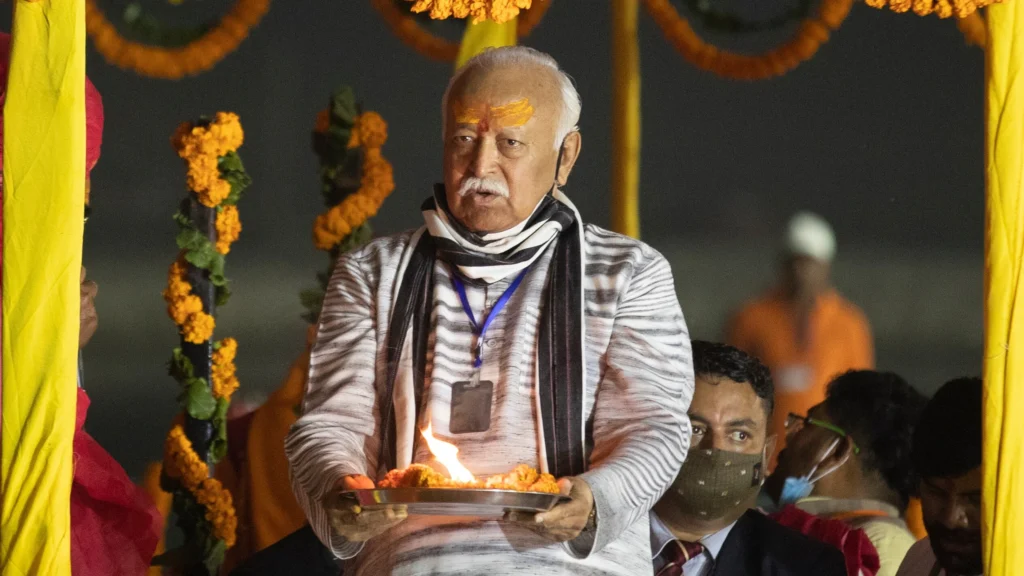
New York, August 30: Rashtriya Swayamsevak Sangh (RSS) chief Mohan Bhagwat stood before a packed hall at Madison Square Garden’s Infosys Theatre on Saturday and spoke straight to the Indian community living in the United States. His message was simple and clear. India remains your janma bhumi — the land of your birth. But the country where you now live, work and earn is your karma bhumi — the land of your duty. And that duty comes first.
“What is our duty? We are in America, we live in America, we earn in America. So we are American. And we should behave true to America,” Bhagwat told the gathering of more than 6,000 Indian-Americans and interfaith leaders. “The diaspora, Bharatiya diaspora, they have a duty to their karma bhumi. They must fulfil that. They should be loyal to their karma bhumi.”
The event, called the Universal Oneness Celebration, was organised by American Hindus for Engagement and Dialogue (AHEAD). Bhagwat’s nearly hour-long address mixed civilisational ideas with practical advice for people who have built lives far from home. He did not ask the diaspora to turn away from India. He simply set an order of priorities.
If someone feels an urge to do something for Bharat after meeting their responsibilities in America, that is fine, he said. “It is not prohibited. But it is not obligatory.” What India does expect, he added, is that people carry the values they received from their motherland into their daily lives. The most important of those values, according to him, is oneness — the sense that we are connected to other human beings and to nature.
Bhagwat drew a parallel between America’s idea of pluralism and India’s long-standing phrase “unity in diversity.” Both, he said, sit in the DNA of the two societies. “We are one, and due to diversity, that oneness is decorated. So diversity has to be celebrated, respected, and accepted. And at the same time, we must keep in mind this feeling of oneness.” He invoked Swami Vivekananda to underline that every nation has a destiny to fulfil. Bharat’s role, in his view, is to keep showing the world that unity and diversity can live together — not through lectures, but through practice.
The speech went beyond the diaspora question. Bhagwat spoke about the limits of material success. Earning well and collecting things is not the full measure of a life, he suggested. People depend on farmers, workers, families and the wider society. That dependence creates a responsibility to give something back. He also touched on the tension between development and the environment, saying the old Indian approach of balance offers a way forward that neither destroys nature nor freezes progress.
For many in the audience, the core line about karma bhumi carried particular weight. Large numbers of Indian-Americans have built successful careers in technology, medicine, business and academia. They send money home, stay connected to family, and take part in cultural events. At the same time they pay taxes, raise children who grow up American, and contribute to the communities around them. Bhagwat’s framing gave that dual reality a clear language: first be a good citizen where you live; the link to India remains through values and, if circumstances allow, through voluntary help.
He was careful not to create a sense of obligation toward India. “Your janma bhumi expects you to live the values it has imparted on you,” he said. The expectation is cultural and ethical rather than financial or political. Live the idea of oneness. Respect diversity while holding on to the feeling of unity. Give back to the society that supports you. That, in his telling, is how the diaspora fulfils its connection to Bharat while remaining true to America.
The gathering itself reflected the themes he raised. Interfaith leaders spoke before Bhagwat about oneness and mutual help. The audience came from different professions, different parts of India, and different generations. Some had arrived decades earlier; others more recently. The setting — one of New York’s best-known venues — underlined how established the Indian presence has become in the United States.
Bhagwat’s remarks fit a broader pattern in his public speaking. He often returns to the idea that nations are more than maps and that civilisations carry responsibilities. In New York he applied that thought directly to people living between two homes. Be loyal to the place that gives you work and livelihood. Carry the deeper values from the place that shaped you. Do not treat either relationship as a burden or a transaction.
By the time he finished, the central message had been repeated in different words but remained consistent. In America, behave true to America. Fulfil the duties of the karma bhumi. The janma bhumi will continue to live in the values you practise every day. Anything more is welcome if it comes after that foundation is secure, but it is not demanded.
The speech is already circulating among Indian community groups and in media coverage back home. For many who heard it in person or later online, it offered a practical and respectful way to think about belonging in two places at once — without guilt, without conflict, and with a clear sense of priority.
Sources:
Hindustan Times, India Today, ANI, IANS, The Times of India, ThePrint (PTI), India TV, The Indian Express, Rediff, News9live (reports dated August 30, 2026, covering Bhagwat’s address at the Universal Oneness Celebration, Madison Square Garden, New York, August 29, 2026).
@Rohit Manral