
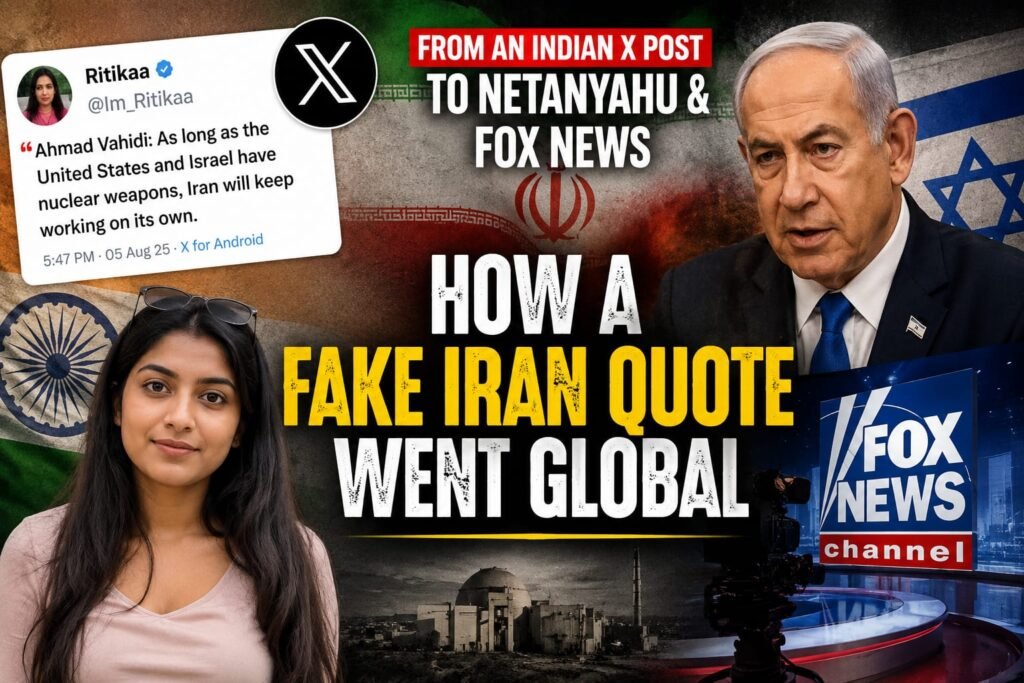
It started with a verified X account called @Im_Ritikaa, display name Ritikaa. She’s based in India, posts a lot of pro-Israel, Hindu nationalist content, and by all accounts keeps a busy feed. On 5 August, she put out a claim that Ahmad Vahidi, the commander of Iran’s Islamic Revolutionary Guard Corps, had said something along the lines of: as long as the United States and Israel have nuclear weapons, Iran will keep working on its own. No video, no audio, no official Iranian statement, no transcript. Just the words, attributed to him.
That was enough.
Within hours the quote started bouncing around Israeli social media. An account that styles itself “Mossad Commentary” picked it up. Then Channel 14, the right-leaning Israeli channel that tends to stay close to Netanyahu’s line, ran with it as if it were a straight news development — the first time a senior Iranian official had openly admitted the country was building nuclear weapons. Yair Netanyahu, the prime minister’s son, amplified it. And then, at a ceremony on Mount Herzl, Benjamin Netanyahu himself referenced the supposed statement in his speech. He treated it as confirmation of what Israel has been saying for years about Iran’s intentions.
From there it crossed the Atlantic. US Ambassador to the UN Mike Waltz shared a version of it, saying Iran was finally admitting what everyone already knew, before later deleting the post. Conservative commentator Mark Levin pushed it further. Fox News reported it, complete with an on-screen headline about Vahidi’s declaration. The claim even made it into the orbit of Republican Senator Rick Scott. For a short window, the fake quote looked like solid international news.
The problem, of course, is that Vahidi never said it. Iranian sources and later reporting found no primary record of the remarks. No speech, no interview, no official communiqué. Israeli journalist Ronen Bergman, writing in Yedioth Ahronoth and later discussed widely on Ynet, traced the entire chain back to that single Indian account. What began as an unverified social-media post was given the appearance of legitimacy by Israeli media, repeated by the prime minister, echoed in the United States, and then reported back in India by agencies citing “Israeli media.” A perfect circular citation loop.
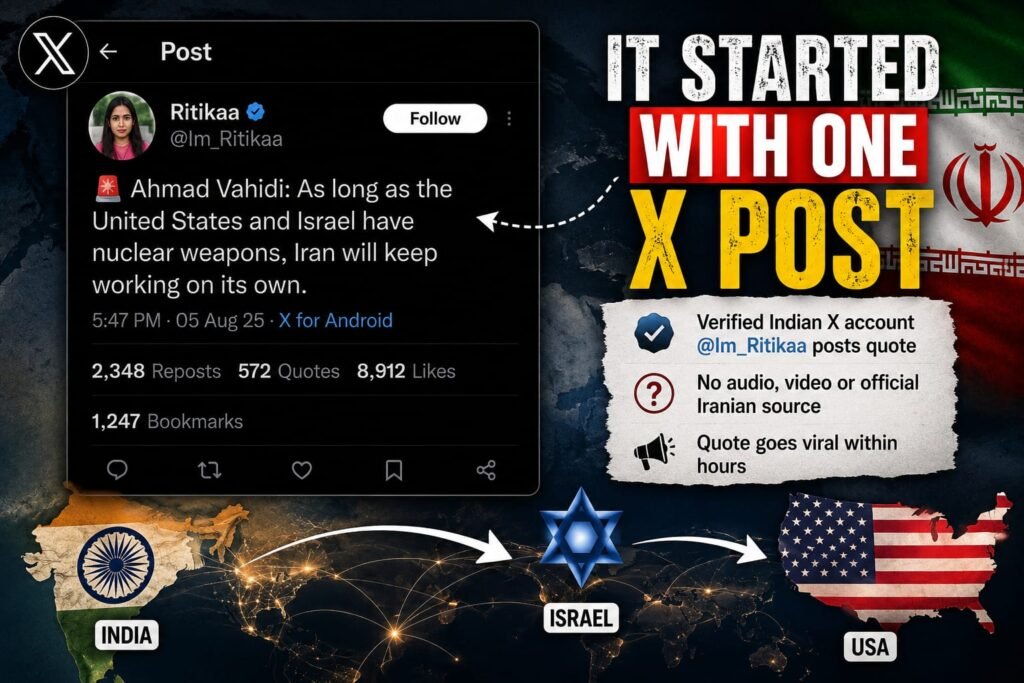
Fox News eventually clarified that the remarks had been taken out of context and amplified as if they were new. Channel 14 and others adjusted their framing after the fact. But by then the damage, or at least the illustration of how fragile the information environment is, was done. A made-up sentence had travelled from an Indian X handle to the highest levels of Israeli politics and into American cable news in a matter of hours.
There’s a certain dark humour in it. An Indian account with a strong pro-Israel tilt manages to feed a narrative that Israeli and American conservative media were already primed to accept. No one seems to have stopped to ask for the original source. In the current climate around Iran’s nuclear programme, the quote was simply too useful to check carefully. It fitted the existing story too well.
Bergman and others have pointed out that this is not an isolated incident. Similar patterns have appeared before — claims that travel quickly, gain official repetition, and only later face scrutiny. In this case the original poster was not some sophisticated intelligence operation. It was a prolific Indian user posting in the open. That somehow makes it more striking. The system that is supposed to filter noise from signal failed at multiple stages: social media amplification, partisan media, political speech, and mainstream American coverage.
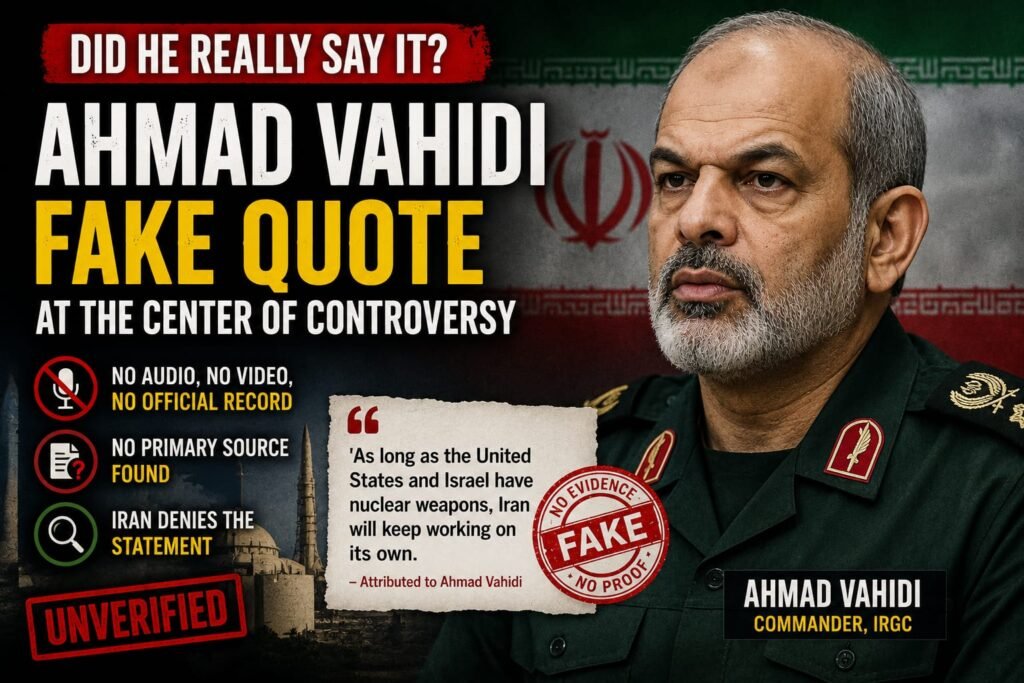
Iran, for its part, denied the statement. Vahidi remains a senior figure, but there is no evidence he delivered the lines attributed to him. The episode has been used by critics of Netanyahu to argue that Israeli messaging on Iran sometimes relies on convenient material rather than hard verification. Supporters of the prime minister might counter that the broader concern about Iran’s nuclear ambitions is real and longstanding, and that one bad quote does not change the underlying assessment. Both things can be true at once. The specific claim was false. The larger strategic worry is not invented.
What stands out most is the speed and the lack of friction. One person in India posts. Israeli accounts boost. A television channel reports. The prime minister speaks. American officials and media follow. Indian agencies then report the story back home as if it originated in Israel. The entire circuit closed in less than a day.
In an age when anyone with a verified account can inject material into global information flows, this episode is a useful reminder. Verification still matters. Primary sources still matter. And the willingness of powerful people and large media organisations to repeat convenient claims without checking them remains a vulnerability. Ritika from India, whoever she is and whatever her motivations, just demonstrated that vulnerability in real time. The system swallowed the pill. It did not taste the fake until after the fact.
Sources: India Today reporting by Shounak Sanyal (10 August 2026); Ronen Bergman’s investigation in Yedioth Ahronoth / Ynet; Middle East Eye summary of the same reporting; contemporaneous X posts and subsequent clarifications by Fox News and related accounts.
@Rohit Manral