
These GDP numbers come out and suddenly everyone’s shouting from the rooftops? One side is cheering 7.8 percent growth in the first quarter, the other is waving papers saying it’s actually closer to 2.5 percent if you dig into the revisions. Former finance secretary Subhash Chandra Garg kicked it off by pointing out that last year’s first-quarter GDP figure had been brought down from around Rs 86 lakh crore to about Rs 80 lakh crore. Use the lower base, he said, and the growth looks much better. Nominal growth would have been under 2.5 percent without that change. Congress jumped on it, questioning the whole methodology, the deflator, the new 2022-23 base series. The government hit back saying you can’t mix old series with new series like that.
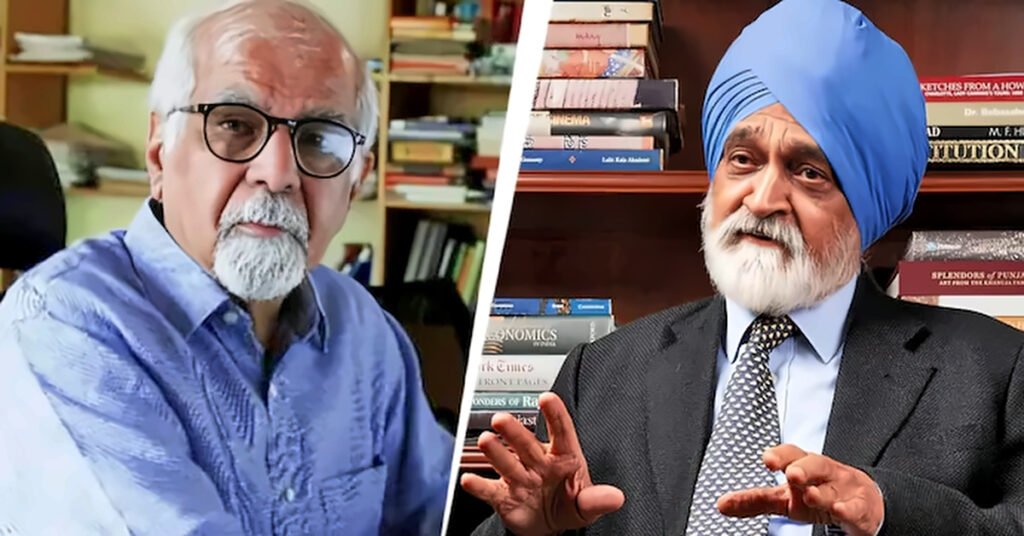
So Rajdeep Sardesai pulled in a few people who actually know this stuff cold – Surjit Bhalla, Montek Singh Ahluwalia, and Neelkanth Mishra – and they sat down to sort through the noise. What came out was pretty clear on one point: none of them saw evidence that the numbers were cooked for political reasons.
Bhalla was straight about it. He said he specifically went looking to see if the revisions were designed to juice up the growth rate. “I come out squarely that there is no evidence to date that we have played politics with the numbers.” When someone asked him directly about political influence on the downward revision, he didn’t hedge: “Absolutely no politics.” He pointed out something simple. If the government wanted to pad the numbers, why leave consumption looking weaker in the new data than the old one? Consumption is hard to measure properly, and it was revised lower. At the same time, independent data shows investment has gone up, and investment feeds straight into GDP. India’s national accounts people, he added, are among the most conservative statisticians he’s come across.
Mishra explained the revision itself in practical terms. Fast-growing economies with a big informal sector have to reset their base and methods every few years. India had gone about a decade without a proper reset. When you bring in new surveys and new source data, the overall numbers can move up or down. You simply cannot compare the old series with the new one. Different methodology, different inputs. It’s not apples to apples. Nominal GDP was actually revised down by about 4 percent under the new series. Why would any government do that if the goal was to look stronger? A chunk of the downward revision came from services – trade, hotels, the more informal parts – where the old assumption that the informal sector tracks the formal one pretty closely no longer held as well.
Ahluwalia agreed that the 2.5 or 2.6 percent alternative calculation doesn’t hold when you mix series. But he also said quarterly numbers always need a pinch of salt. They’re based on preliminary information. You can’t look at the first quarter and declare what the full year will be. He did flag a fair technical question though: why do these base changes in India tend to revise GDP down, when some other countries see upward revisions? Once the full details come out from the statistics people, economists will need to look carefully at the reasons. Still, he wasn’t buying the idea that the 7.8 percent was manufactured.
On the bigger picture – has India proved the doomsayers wrong? – the views were more measured. Mishra said he had expected something around 7.5 percent for the year anyway, so 7.8 percent wasn’t a shock. Last year there were fiscal and monetary headwinds. Once those ease, growth can pick up even if the global picture stays messy. Ahluwalia put it this way: you could say the economy looks more resilient than the doomsayers claimed. Even if the full-year number settles closer to 7 percent than 7.8 percent, that would still be faster than most major developing economies. But one strong quarter is no reason to sit back. “You can’t look at these data and say, ‘I told you so.’” He wants the conversation to move from general talk about reforms to actual lists of what needs fixing – private investment, institutions, the things that determine whether growth stays high for years, not just one quarter.
Prime Minister Modi did take a dig at the sceptics after the numbers came out, saying the doomsayers were doomed and India bloomed again. Fair enough for a political moment. But the economists on that roundtable kept coming back to the same place. The 7.8 percent isn’t fake. The revision process is messy because measuring a large informal economy is messy. Mixing old and new series creates confusion that looks like foul play when it isn’t. And a good quarterly print doesn’t erase the longer-term challenges – jobs, investment quality, the need for deeper reforms if the Viksit Bharat target is going to mean anything.
That’s where they left it. No grand conspiracy, no reason to dismiss the growth either. Just data that needs to be read carefully, revisions that happen for technical reasons, and an economy that is performing better than the darkest forecasts but still has real work ahead. The debate will keep going, of course. These numbers always do. But the people who’ve spent careers staring at the national accounts say the politics-of-data charge doesn’t hold up this time.
Sources:
India Today (Anand Singh report on the Rajdeep Sardesai Roundtable, 4 September 2026); Business Today coverage of the same discussion; statements from Surjit Bhalla, Montek Singh Ahluwalia and Neelkanth Mishra during the India Today TV debate; Subhash Chandra Garg’s earlier comments on the revision; official GDP releases from the Ministry of Statistics and Programme Implementation.
@Rohit Manral