
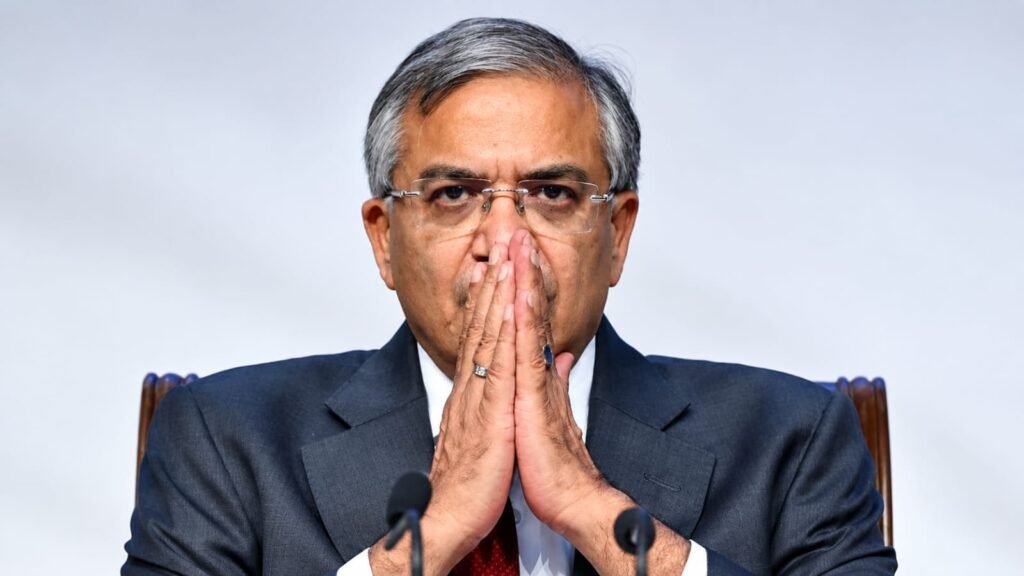
The Election Commission of India used to be one of those rare institutions people still trusted. In a country as noisy and divided as ours, that mattered. You could argue about parties, about governments, about almost everything else, but the EC was supposed to be the referee that stayed clean. That reputation is taking a beating right now, and this time the cracks are showing from inside the building itself.
The latest spark came from a detailed investigation by The Indian Express. It reported that the two other Election Commissioners — Sukhbir Singh Sandhu and Vivek Joshi — had formally objected, on the record, at least 14 times in the past 10 months to decisions taken under Chief Election Commissioner Gyanesh Kumar. Many of those decisions, they said, were made without their knowledge. We’re talking about changes to how new voters get enrolled (Form 6), the way names were deleted and restored during the Special Intensive Revision of electoral rolls, and the centralisation of the voter database itself. In one case the two commissioners even wrote to the Cabinet Secretary complaining about what they saw as a clear violation of the law governing the Commission.
That is not normal. The Election Commission is a three-member body. Decisions are supposed to be by majority, ideally by consensus. When two of the three keep raising red flags and still get overruled or kept out of the loop, it starts looking less like internal debate and more like one man running the show. The Commission’s response has been that differing views are part of the process and that all final decisions were unanimous. But it has not answered the specific questions the two commissioners put on paper — who authorised certain changes, why the full Commission did not meet for stretches, who filed appeals on the Commission’s behalf in West Bengal, and so on.
This is not happening in a vacuum. The Special Intensive Revision, or SIR, started in Bihar last year and has since rolled out across many states. The Commission says it is simply cleaning up rolls that had not seen a proper intensive revision in decades — removing the dead, the duplicates, the people who have moved. Fair enough in principle. But the scale has been massive. In Bihar alone the draft list dropped by around 65 lakh names. Across 30 states and Union Territories, more than 13 crore names have been struck off draft rolls. In West Bengal the numbers were especially raw — roughly 27 lakh deletions in the later stages, with judicial officers later restoring a large share of those who appealed. When nearly nine out of ten appeals succeed, you have to ask how many genuine voters got knocked off in the first place.
Opposition parties have been screaming about this for months. Rahul Gandhi has called it “vote chori.” He has pointed to specific constituencies, like Mahadevapura in Karnataka during the 2024 general elections, claiming tens of thousands of dubious entries — duplicates, fake addresses, bulk registrations at single locations. Other parties have joined in, especially in states where elections are coming or have just happened. They say the process put the burden of proof on ordinary voters, many of them migrants, the urban poor, or people without the exact documents the Commission demanded. Some of those documents were the ones people actually use every day; the list of acceptable papers felt designed to exclude rather than include.
The Commission and the ruling side push back hard. They say the opposition is crying foul because it lost. They insist every deletion can be challenged, that appeals mechanisms exist, and that cleaning the rolls is necessary for the integrity of elections. Dead people and double voters have no business on the list. Fair point. But the optics have been terrible. When the same institution that is supposed to be neutral starts looking opaque — refusing machine-readable lists for a while, destroying CCTV footage faster than before, centralising software control in Delhi against the objections of its own commissioners — trust erodes.
There is a deeper background here that makes the current storm worse. The way Election Commissioners are appointed changed in 2023. The Supreme Court had wanted a panel that included the Chief Justice. Parliament replaced the CJI with a Cabinet minister nominated by the Prime Minister. The opposition always said that gave the government a built-in 2-1 majority. Every appointment since has been viewed through that lens. When the man at the top of the Commission is seen as close to the government of the day, every controversial decision gets read as political, whether it is or not.
Former Election Commissioners have called the internal dissent “unprecedented” and “very serious.” Opposition leaders are demanding Kumar’s resignation, some even talking of arrest or impeachment. A few are calling for the SIR to be paused and for court-monitored inquiries. The ruling party calls it an attack on the referee by sore losers.
What is actually at stake is bigger than one Chief Election Commissioner or one revision exercise. In a democracy of this size, the only thing that keeps the peace is the shared belief that the count is honest. When large numbers of people start believing the voter list itself is being gamed — whether by over-enthusiastic cleaning or by selective blindness — that belief frays. Once it frays far enough, every result becomes contestable, every loss becomes theft, and the referee loses the authority to blow the whistle.
The Election Commission still has the legal powers and the institutional memory to fix this. It can open its processes, answer the specific objections on record, restore genuine voters quickly, and show that majority decision-making inside the Commission is real. Whether it chooses to do that, or digs in, will decide if this storm passes or becomes the new normal. India’s democracy is loud and messy by design. It cannot afford a referee that looks like it has picked a side — or worse, looks like it is no longer even listening to its own colleagues.
Sources: The Indian Express investigation (23-24 September 2026); BBC News reporting by Geeta Pandey (24 September 2026); The Hindu editorials and explainers; New York Times coverage of the voter-roll revisions; statements from the Election Commission of India and opposition leaders as reported across major Indian outlets.
@Rohit Manral