
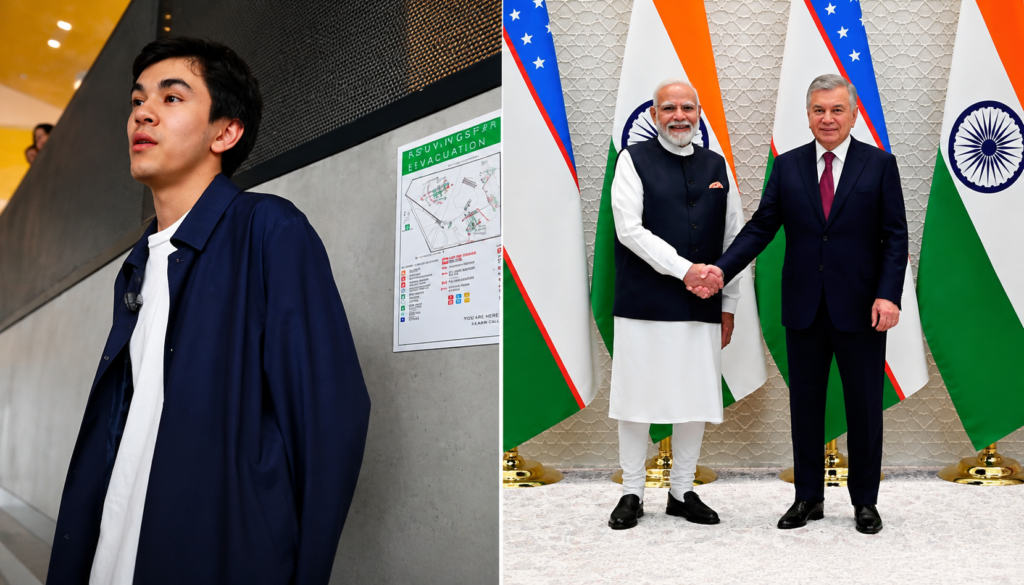
Instead of just the usual formal stuff, he handed President Shavkat Mirziyoyev the original handwritten scoresheet from Javokhir Sindarov’s World Cup final win in Goa last year. The actual piece of paper where the moves were written down. It came in a simple leatherette cover, along with a photo of Sindarov holding the trophy with the Uzbek flag around his shoulders.
Pretty cool, right?
Nitin Narang, the AICF chief, put it perfectly. He said a scoresheet normally just records the moves on the board. But sometimes it becomes part of a much bigger story. From Sindarov’s big win in Goa to becoming a gift from our PM to the President of Uzbekistan… chess has this quiet way of connecting people and countries. “Chess diplomacy, quite literally,” he wrote. And that line just lands.
Quick rewind. Last November in Goa, young Sindarov became the youngest-ever FIDE World Cup champion. He beat China’s Wei Yi in the tiebreaks after the classical games were drawn. That win got him into the Candidates. He went on and won that too. So now, later this year in Geneva, he’ll sit across from our own Gukesh for the world title. Two young guys, one from each country, going head-to-head for the biggest prize in chess. Makes that scoresheet feel kind of special.
Modi gave it during his visit that also covered the SCO summit. Along with it he also gifted a sandalwood santoor (the one that looks a lot like Uzbekistan’s traditional Chang) and some premium Kangra tea in a nice wooden box. Culture, music, and a little piece of chess history from Indian soil that celebrated an Uzbek hero. Feels thoughtful more than formal.
Chess has always had this soft power thing going on. People still talk about ping-pong diplomacy from way back. Here the chessboard itself became the bridge. India hosted the tournament where an Uzbek kid made history. Now the paper record of that history has been gifted back by India’s Prime Minister. It’s a nice full circle.
Both countries take the game seriously. We’ve got Gukesh as world champion and a whole bunch of young talent. Uzbekistan has been punching above its weight for years, and Sindarov is their brightest star right now. The next Olympiad is coming up in Samarkand, so the friendly rivalry is only going to get warmer.
What makes the gift land is how ordinary the object is. Every tournament player has filled out hundreds of those sheets — messy handwriting, little corrections, the whole thing. Yet this one captured a national moment for Uzbekistan on Indian ground. Handing it over quietly says: we saw it, we respect it, and we’re happy to share the pride. No big speeches needed.
Narang’s words feel honest. Chess really does connect people in a natural way. Kids in both countries are learning the same openings, following the same top players, dreaming the same dreams. When leaders exchange something as personal as a scoresheet from a shared event, it stops feeling like diplomacy and starts feeling like two friends swapping a meaningful souvenir.
Of course the bigger relationship between India and Uzbekistan has trade, connectivity, security and all the serious stuff. But these small human touches matter. They give people something warm and real to talk about. Fans in both places can smile at the idea that the paper from that tense final in Goa now sits with the Uzbek President, given by the Indian PM.
Sindarov’s journey keeps going — from prodigy to World Cup winner to Candidates champion, and soon a title match against Gukesh. Whatever happens in Geneva, the story already has this extra chapter written by a simple scoresheet that travelled from the playing hall in Goa all the way to a meeting in Tashkent.
In the end it’s a reminder that sports diplomacy doesn’t always need huge stadiums or fancy events. Sometimes it’s just a piece of paper with moves written on it, carefully kept and thoughtfully given.
Chess diplomacy, quite literally. And it works.
Sources:
Times of India, Indian Express, News18, ANI, Times Now, CNBC TV18, India Today (1–2 September 2026)
@Rohit Manral