
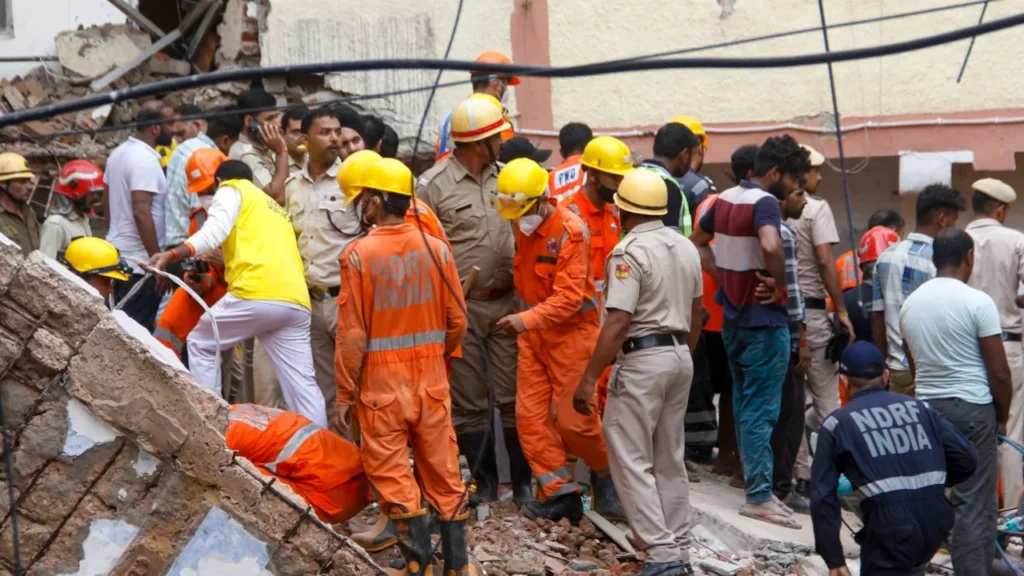
The building with cracked walls, damp patches that never dry, and pillars that feel like they’re holding on out of habit more than strength. That’s exactly what this building in Satya Niketan was. Fifty years old, give or take a few. Built when the area was still a resettlement colony for ordinary families, not the packed student hub it is today. For years it stood there near Delhi University’s South Campus, quietly aging. Then greed stepped in and decided the old structure still had more money left in it.
On Sunday afternoon, 6 September 2026, around half past one, the five-storey building known as Hostel Daze simply gave up. It came down in a roar that neighbours said felt like a sudden tremor. Students were inside. Some were sleeping because it was a weekend. Labourers were working below. Within minutes the place turned into a pile of concrete and twisted rods. At least five people died. Several more were pulled out injured. Rescue teams from the NDRF, fire services, police and disaster management spent hours digging through the rubble while friends and classmates waited outside, some still getting calls from people trapped underneath.
The building had a basement and five floors above. It was being run as a boys’ paying guest accommodation. Roughly 75 beds, rooms packed, rent around twelve to fifteen thousand rupees a month per student. Ground floor had a mess and a medical shop. Upper floors housed young men from places like Kerala, Haryana, Uttar Pradesh, studying at Motilal Nehru, ARSD, Sri Venkateswara and other nearby colleges. For many of them this was the only affordable option close to campus. The whole of Satya Niketan has turned into a PG jungle. Old single-family houses stretched upwards and sideways without much care for rules. Owners often shifted out to Gurgaon or elsewhere and simply collected rent online.
What finished this particular building was the work going on in the basement. Locals and early accounts say water had been collecting there after recent rains. The foundation was already weak. Yet renovation continued. Some say they were trying to create more usable space or fix the waterlogging. Others say a wall was being removed and pillars were being disturbed while the upper floors stayed occupied. Chief Minister Rekha Gupta said preliminary information pointed to excavation that shifted a pillar. The upper part may have been reinforced a bit, but the base was old and tired. When you dig under a structure that was never meant to carry five floors of students and their belongings, something eventually gives.
The owner is named in reports as Hariram or Hari Ram Bansal, with family members including Anand Bansal mentioned in connection with the property. He lives in Gurugram these days. Police registered an FIR against him and others under sections dealing with culpable homicide not amounting to murder, negligent construction, and endangering lives. Teams are looking for him. The building had apparently been vacated at one point because of its condition, then brought back into use as a PG. No fire NOC, height beyond what was allowed for the plot, extra floors added over the years on what started as a much smaller structure. Classic story.
This is not some rare accident. Satya Niketan itself saw a renovation collapse a few years ago that killed labourers. Across Delhi the pattern keeps repeating: old buildings, illegal additions, water seepage, rain, and owners squeezing every last rupee until the structure can’t take it anymore. Civic agencies get complaints, sometimes inspect, sometimes book violations, but real action often comes only after the rubble is on the road. Residents here talk about open drains, constant waterlogging on the sloping lanes, and buildings going up to five or six floors on tiny plots meant for far less. Owners treat these places like pure investments. Students treat them like temporary roofs. Nobody treats them like places that need regular structural checks.
Think about the young people who lived there. Many had just come back from home or stayed over the weekend. Parents had sent money for rent thinking their children were safe near college. Instead, some are now in hospital, others are gone. Colleges nearby opened their gates so displaced students could sleep on campus that night. Friends formed human chains to help with the rescue. The usual political statements followed, inquiries were ordered, promises of strict action were made. We have heard all this before.
The real problem sits in plain sight. A fifty-year-old building that was already dying was kept alive by the promise of steady rent from students who have nowhere else affordable to go. Basement work continued even when the foundation was compromised. Water was allowed to sit. Extra floors stayed put. Regulations existed on paper. Enforcement stayed soft. When the crash finally came, everyone acted shocked.
These buildings do not collapse out of nowhere. They are pushed. Greed keeps adding weight until the old bones cannot hold. Until the next one falls, the cycle continues: another old structure, another set of students, another round of rescue, another FIR, another inquiry. The people living and studying in these lanes already know the truth. The rest of us only notice when the dust rises.
Sources:
- Delhi Police statements & FIR details (ANI, PTI)
- Chief Minister Rekha Gupta’s on-site remarks
- The Print, Times of India, India Today, The Statesman, News18, Tribune reports (6 Sept 2026)
- Local eyewitness & resident accounts carried by above outlets
- AIIMS Trauma Centre updates on casualties
@Rohit Manral