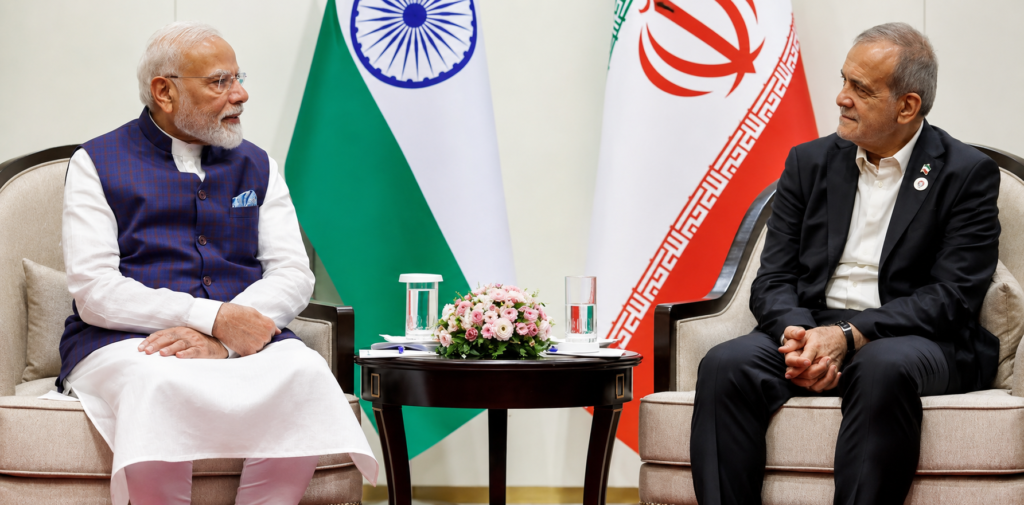
A senior U.S. official cautioned against reading too much into Prime Minister Narendra Modi’s recent meeting with Iran’s President Masoud Pezeshkian, saying a face-to-face conversation shouldn’t be taken as proof that India and Iran are striking a new strategic deal. The message was simple: leaders meet and talk — that doesn’t automatically mean they have inked an agreement that changes regional calculations.
The meeting took place during a regional diplomatic gathering and attracted attention because of India and Iran’s history of economic and connectivity ties. Projects like Chabahar port have long been a practical link between the two countries, driven by trade, energy and access to Afghanistan and Central Asia. Those ties are real, but the U.S. official — who spoke on background — wanted to be clear that routine diplomacy does not equal a treaty or a sudden shift in alignment.
“Don’t jump to conclusions,” the official said. “A meeting is not a treaty. It’s not proof of a secret alignment.” The remark reflects Washington’s ongoing concern about Iran’s regional ambitions and the desire to avoid any misreading that could suggest India is moving into a deeper partnership with Tehran that would complicate U.S. policy.
India’s proceed towards Iran has been sensible. New Delhi balances its growing strategic relationship with the United States against long-standing economic and regional interests. Supporting Chabahar, for example, is framed as development and connectivity work rather than a geopolitical statement. For India, energy security, trade routes and regional access drive engagement with Tehran, even as New Delhi expands defense and technological ties with Washington.
From the U.S. outlook, that dual approach is understandable but monitored. The official stressed that while Washington esteem India’s choices, it also watches for moves that might have wider implications. “India is an important partner for us,” the official added. “We respect their interests but we will continue to engage to protect mutual concerns.”
Observers noted the official’s comment had two aims: to temper any suggestion of a clandestine alliance, and to remind partners that transparency about dealings with Iran matters. Even low-key talks can matter over time — repeated contacts build trust and communication channels — but a single meeting should not be hyped into a strategic turning point, the official said.
Analysts caution that India’s long-standing policy of strategic autonomy—pursuing relationships based on national interest rather than fixed blocs—explains why New Delhi talks with a wide range of countries, including Iran. Tehran, meanwhile, is eager to expand economic ties to soften the impact of international isolation, and India’s projects in Iran are attractive for their immediate practical benefits.
Not everyone agrees the meeting was inconsequential. Some regional experts argue that incremental diplomacy can slowly shift relationships, and continued high-level dialogue is worth watching. Western and regional capitals will look for follow-up steps — any trade deals, memoranda, or infrastructure commitments that would suggest talks are turning into concrete cooperation.
For now, the Core insight from Washington is straightforward: conversations happen, but they are not automatically deals. The U.S. wants clarity and accountability from partners when their interactions involve Iran, and it will keep engaging with India to ensure mutual interests are protected.
Sources
- Statement from unnamed senior U.S. administration official (quoted on background).
- Background on India–Iran ties and Chabahar port project: Ministry of External Affairs, Government of India; reporting by major international outlets covering regional diplomacy.
- Analysis of India’s strategic autonomy and regional policy: academic commentary and policy think-tank briefings on South Asia–West Asia relations.
@Rohit Manral